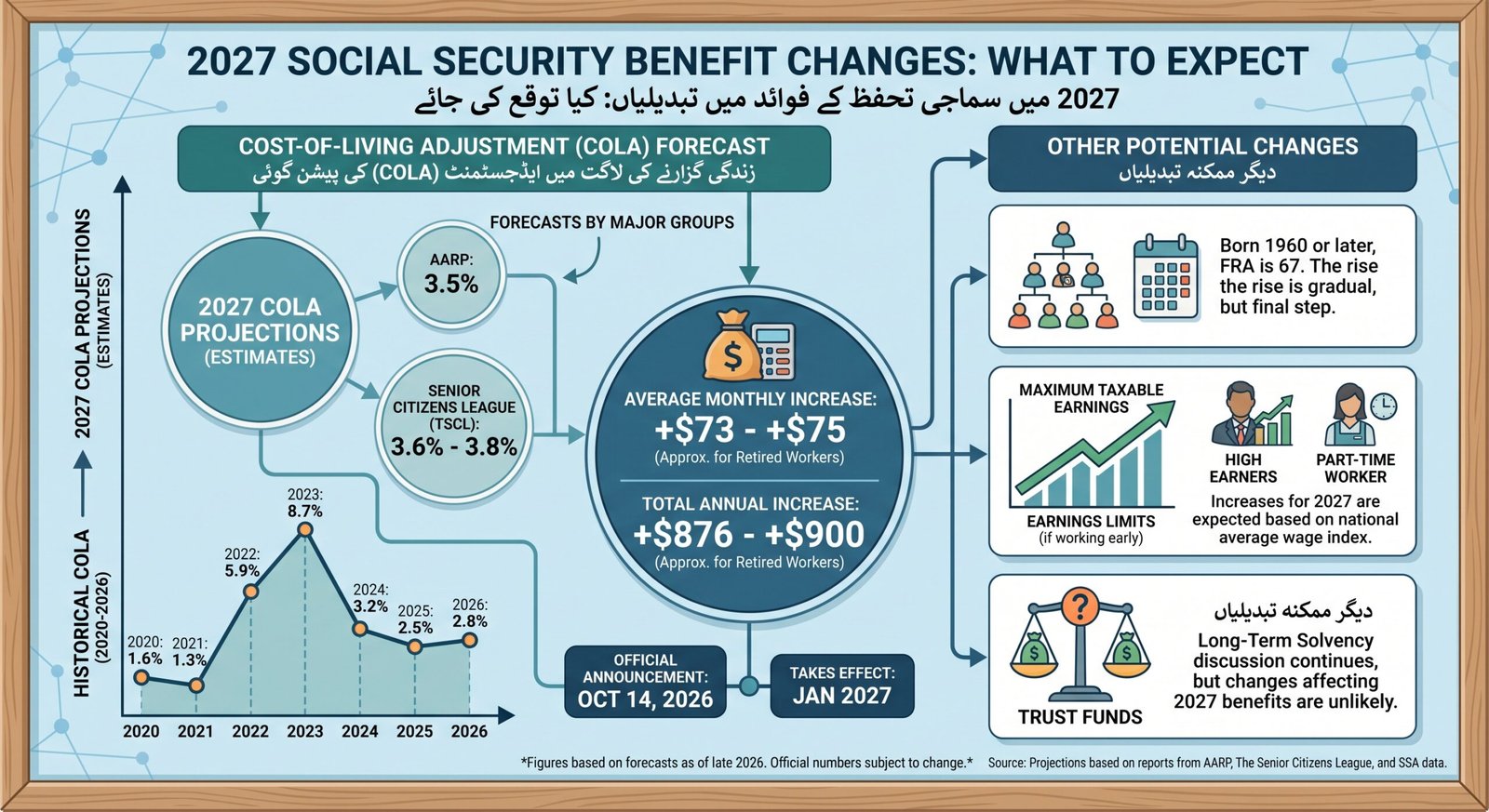
Social Security is expected to change in several important ways in 2027, although many final figures will not be official until the Social Security Administration announces them later in 2026. The biggest expected update is a cost-of-living adjustment, or COLA, intended to help benefits keep pace with inflation. Current forecasts place the possible increase in the mid-3% range.
For retirees, disabled workers, survivors, and future claimants, it is important to separate confirmed rules from estimates. A higher monthly benefit can help, but Medicare premiums, taxes, and everyday living costs may reduce the practical value of the increase. Understanding the 2027 social security benefit changes now can help you plan your budget and claiming strategy with more confidence.
Quick Bio
What Are 2027 Social Security Benefit Changes?
The phrase 2027 social security benefit changes refers to expected updates affecting monthly payments, taxable earnings, work rules, and retirement eligibility. These changes are generally driven by inflation data, wage growth, and rules already written into federal law.
The most discussed change is the annual COLA. Social Security uses an inflation measure tied to the Consumer Price Index for Urban Wage Earners and Clerical Workers, commonly called CPI-W, to determine whether benefits rise. Tracking these 2027 social security benefit changes helps beneficiaries anticipate how their income may shift in the coming year.
Expected 2027 COLA Increase
Several recent estimates suggest the 2027 COLA could range from about 3.2% to 3.6%. The Senior Citizens League projects a 3.6% increase, while other forecasts have placed the figure closer to 3.4% or 3.5%.
These figures are only projections, not final benefit decisions. The official COLA depends on inflation readings for July, August, and September of 2026, with the final announcement traditionally expected in October. As part of the broader 2027 social security benefit changes, this adjustment will directly impact the size of monthly checks starting in January 2027.
What a Higher Check Could Mean
A 3.6% adjustment would add roughly $70 per month to an average retiree benefit in some forecasts. The actual dollar increase will vary because each person’s payment is based on their work record, claiming age, and benefit type.
For example, someone receiving $2,000 per month could see an increase of about $72 under a 3.6% COLA. That would bring the gross monthly payment to approximately $2,072 before Medicare deductions or any income-tax impact. These potential 2027 social security benefit changes matter most to people relying on Social Security as a primary income source.
Old Rules and New Expectations
Social Security has provided automatic annual COLAs since the mid-1970s. The purpose is simple: benefits should not lose as much buying power when prices rise for food, housing, utilities, health care, and other necessities.
For 2026, Social Security recipients received a 2.8% COLA. A projected 2027 adjustment around 3.4% to 3.6% would be larger, potentially making it the biggest annual increase since 2023. When evaluating 2027 social security benefit changes, it helps to compare this expected raise with recent years to understand the trend.
No Scheduled Benefit Cut
There are no scheduled across-the-board Social Security benefit cuts for 2027 under current law. Claims that all benefits will automatically be reduced in 2027 should be treated carefully, because the program’s long-term financing debate is different from an immediate, scheduled cut.
Long-term trust-fund concerns remain important, but Congress would need to take action to change benefit formulas, payroll taxes, eligibility rules, or other major program features. Beneficiaries should focus on official announcements rather than alarming headlines when reviewing 2027 social security benefit changes.
Earnings and Payroll Tax Changes
Workers pay Social Security payroll taxes only up to the annual taxable wage base. This ceiling normally increases over time as national wages rise, meaning higher earners may contribute Social Security taxes on more of their income.
The taxable earnings cap was $184,500 in 2026, and one forecast estimated it could rise to about $190,200 in 2027. That amount is not final and will be set officially by the Social Security Administration. This potential increase is one of the less-discussed but still important 2027 social security benefit changes for workers and employers.
Working While Collecting Benefits
People who claim retirement benefits before reaching full retirement age can face temporary withholding if their earnings exceed the annual limit. The limit is adjusted periodically, so workers planning to earn wages in 2027 should check the final threshold before estimating their cash flow.
A forecast cited a possible lower earnings-test threshold of roughly $25,200 for 2027, compared with about $24,480 in 2026. Once a beneficiary reaches full retirement age, the earnings test no longer applies. These rules are a key part of the 2027 social security benefit changes for anyone working while collecting early retirement benefits.
Full Retirement Age Rules
Full retirement age, or FRA, is the age when a worker can receive their standard Social Security retirement benefit without an early-claiming reduction. For people born in 1960 or later, the full retirement age is 67 under current law.
This rule is already established, so it is not a new 2027 policy. However, more Americans reaching retirement age will encounter the age-67 benchmark, making it a major planning issue for people deciding whether to claim at 62, at full retirement age, or as late as 70. Understanding this context is essential when interpreting 2027 social security benefit changes.
Claiming Earlier or Later
Claiming at age 62 gives a worker benefits sooner, but it permanently reduces the monthly amount. Waiting beyond full retirement age can increase a retirement benefit through delayed retirement credits until age 70.
The best claiming decision depends on health, savings, work plans, family longevity, spousal benefits, and monthly spending needs. A projected COLA does not change the basic tradeoff between claiming early and delaying for a larger lifetime monthly payment, even as 2027 social security benefit changes unfold.
Medicare and Tax Considerations
A larger Social Security payment does not always equal a larger amount deposited into a bank account. Many retirees have Medicare Part B premiums deducted directly from their benefits, and higher premiums can offset part of a COLA increase.
Federal income taxes may also apply when a recipient has enough combined income from wages, pensions, investments, or other sources. Retirees should review their full budget instead of looking only at the headline percentage increase. These factors can soften the real-world impact of 2027 social security benefit changes on household cash flow.
Inflation Still Matters
A larger COLA usually reflects higher inflation, which means retirees may also be paying more for essentials. Costs such as prescription drugs, rent, property taxes, insurance, and groceries can rise at different rates than the inflation measure used for Social Security adjustments.
This is why the expected 2027 social security benefit changes may feel more helpful to some households than others. A retiree with rising medical bills may experience a smaller real improvement than a household with stable expenses, even with a bigger nominal COLA.
Latest News
The latest forecasts place the possible 2027 COLA near 3.4% to 3.6%, though estimates have moved as inflation data changed. AARP has estimated 3.5%, while The Senior Citizens League has projected 3.6%.
The final number is still uncertain. Beneficiaries should wait for the official fall announcement, then review their Social Security notice to see the exact new monthly amount beginning in January 2027. Staying updated on 2027 social security benefit changes ensures you can adjust your retirement plan with accurate information.
Legacy and Impact
Social Security remains a core income source for millions of older adults, disabled workers, and families of deceased workers. Annual adjustments are designed to preserve purchasing power, even though they cannot perfectly match every household’s personal expenses.
The 2027 social security benefit changes will matter most to people living on fixed incomes. A modest increase can provide useful support, but planning for health costs, taxes, inflation, and work income remains essential for long-term financial stability.
Conclusion
The expected 2027 Social Security benefit changes center on a possible COLA of roughly 3.2% to 3.6%, along with potential increases to the taxable wage cap and earnings-test limits.
The final rules and amounts will come from the Social Security Administration. Until then, recipients should treat projections as planning estimates, not guaranteed payments. Keeping an eye on 2027 social security benefit changes will help you make smarter decisions about claiming, working, and budgeting in retirement.
FAQ
What are the main 2027 social security benefit changes?
The main changes include a projected COLA around 3.2%–3.6%, possible increases to the taxable wage cap, and updated earnings limits for people working while collecting early benefits.
When will the 2027 COLA be announced?
The official COLA is generally announced in October after the government releases the relevant third-quarter inflation data.
Is Social Security being cut in 2027?
No across-the-board benefit cut is scheduled for 2027 under current law.
How much could the average check rise in 2027?
Forecasts suggest that a 3.6% increase could add roughly $70 per month to an average retiree benefit, but individual increases will differ.
Will working affect Social Security benefits in 2027?
It can affect benefits for people who are below full retirement age and earn more than the annual earnings-test limit. The threshold is expected to rise, but the official amount is still pending.
Will Medicare premiums reduce the 2027 increase?
They can. Medicare Part B premiums are often deducted from Social Security benefits, so a higher premium may reduce the net amount a beneficiary receives.